The library of functions has been expanded over the years. Which functions are available in which vs | plus version is described in the chapter "Functions in open vs | plus".
There is a detailed description for each function, which is structured as follows:
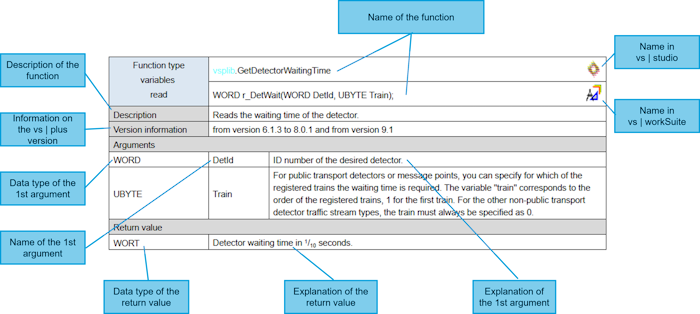
Figure 108: Functional description
Value range of the data types:
|
German |
English |
Definition |
Memory |
Interpretation |
|
BYTE |
UBYTE |
unsigned char |
1 Byte |
0…255 |
|
WORT |
WORD |
unsigned short |
2 Bytes |
0…65535 |
|
LWORT |
LONG |
unsigned long |
4 Bytes |
0…4'294'967'295 |
|
VBYTE |
SBYTE |
signed char |
1 Byte |
- 128 bis 127 |
|
VWORT |
SWORD |
signed short |
2 Bytes |
- 32'768 bis 32'767 |
|
VLWORT |
SLONG |
signed long |
4 Bytes |
- 2'147'483'648 bis 2'147'483'647 |
All functions are categorised into three types. Each of the three types always begins with its own letter.
|
Function type Variables |
|
|
|
r_ |
|


These functions are used to read vs | plus process data.
|
Function type Parameters |
|
|
|
|
p_ |
|
||
These functions are used to read vs | plus parameters.
|
Function type Variables |
|
|
|
|
w_, c_ |
|
||
These functions can be used to modify vs | plus process data.